
Spinal Stenosis Treatment: Non-surgical Options for Pain Relief
You start a walk feeling fine. A few minutes later, your legs feel heavy or tingly, and you need to sit down or lean forward before you can keep going. If you have been diagnosed with spinal stenosis, you may be wondering whether surgery is your only option.
For many people with mild to moderate symptoms, spinal stenosis treatment can begin with non-surgical care focused on reducing discomfort, improving mobility, and helping you stay active. At ChiroSolutions Center in Virginia Beach, we look at how your symptoms, posture, and movement are connected to determine which conservative options may be appropriate for you.
What spinal stenosis is and why bending forward helps
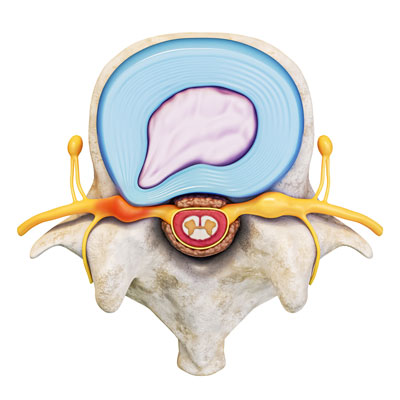
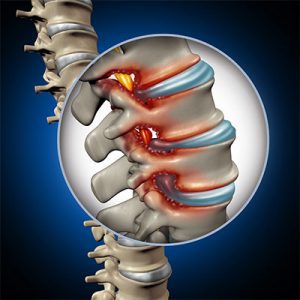
Your spinal canal is a tunnel that runs through the center of your vertebrae and carries the spinal cord and nerve roots. Spinal stenosis is a narrowing of that tunnel. According to the National Institute of Arthritis and Musculoskeletal and Skin Diseases, the narrowing usually develops slowly over time, most often in the lower back and neck, and the chance of developing it rises with age. Bone spurs, thickened ligaments, and bulging discs each take up a little room until the nerves inside get squeezed.
In the lower back, that squeeze shows up as leg symptoms when you walk or stand. In the neck, it can cause arm numbness, clumsy hands, or an unsteady walk. Both types tend to arrive gradually rather than all at once.
Here is the detail that shapes almost every non-surgical option. When you bend forward, the canal opens by a few millimeters. When you lean back, it narrows. That is why leaning on a cart feels good and why standing tall to look at a high shelf feels worse. Doctors call it the shopping cart sign, and it tells us which positions and exercises will help you and which will make things worse. Those same positions also produce a symptom pattern we can recognize.
Symptoms that tell us it is stenosis
- Heaviness, aching, or tingling in one or both legs after walking or standing
- Relief within minutes of sitting down or bending forward
- A walking distance that has slowly shrunk over months
- Unsteady balance or a wider stance when you walk
- In the neck: numb hands, trouble with buttons or handwriting, tripping more often
Because the symptoms of spinal stenosis come on gradually, many people blame age or fitness for years before the diagnosis. A few signs are different. Loss of bladder or bowel control, numbness in the groin, or leg weakness that worsens over days means the nerves are under severe pressure and you should go to an emergency room that day. For everyone else, the question is what to try first.
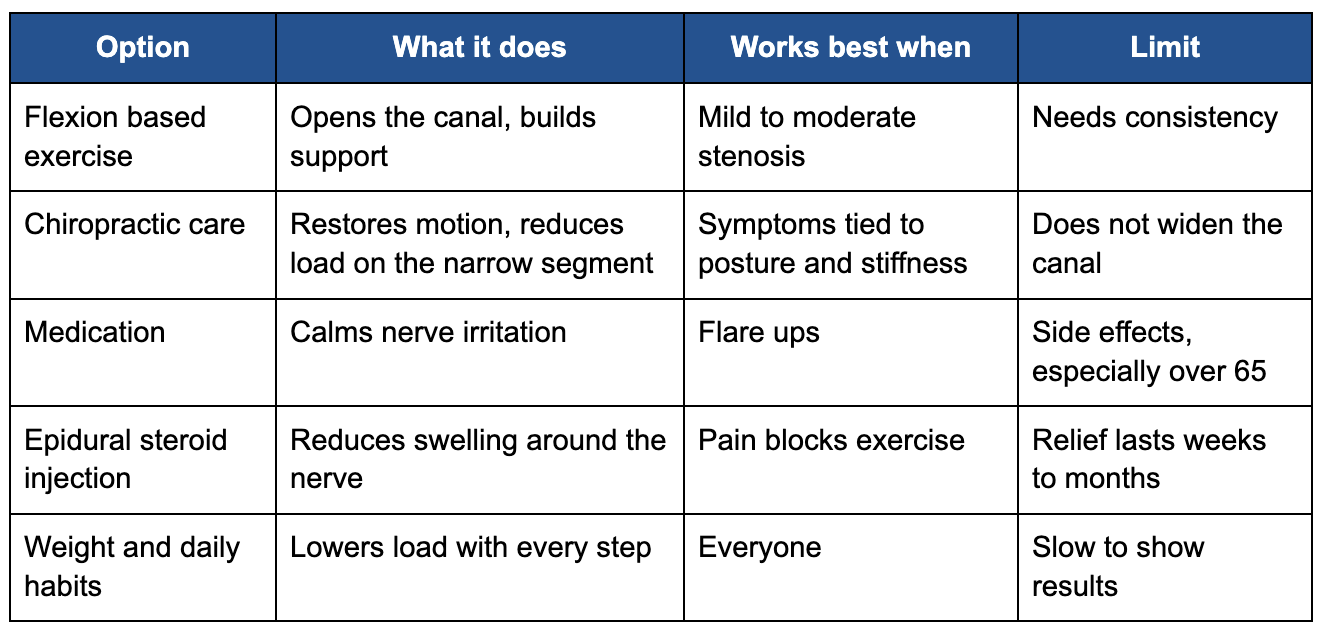
Non-surgical spinal stenosis treatment options
A personalized approach to spinal stenosis care at ChiroSolutions
Spinal stenosis can affect two people very differently, even when their imaging looks similar. At ChiroSolutions Center, we look beyond the diagnosis to understand your symptoms, posture, spinal movement, and how the condition affects activities such as standing and walking.
Based on your individual findings, care may include chiropractic adjustments, corrective exercises, and Chiropractic BioPhysics techniques to address movement and mechanical factors that may be contributing to discomfort. The goal is not to make the narrowing disappear, but to help you move more comfortably and function better in daily life.
We monitor practical changes such as walking tolerance, standing comfort, and leg symptoms rather than expecting everyone to improve on the same timeline. If your symptoms worsen or suggest significant nerve involvement, we recommend further medical evaluation instead of continuing care that may not be appropriate.
Conclusion
Stenosis does not go away, but how much it controls your day can change a great deal. If walking has become something you plan around, we would like to see how your spine is moving and show you what is possible before surgery enters the picture. You can schedule a free initial consultation with us and we will map out a plan built around your walking distance, not your MRI report.
Frequently asked questions
What is the best treatment for spinal stenosis?
For mild to moderate stenosis, the best first line treatment is flexion based exercise combined with care that reduces load on the narrowed segment, such as chiropractic correction and weight management. Medication and injections support that plan during flares.
Can spinal stenosis be treated without surgery?
Yes. Most people with mild to moderate stenosis manage their symptoms with exercise, posture correction, chiropractic care, and short term medication, and never need an operation.
Is chiropractic safe for spinal stenosis?
Chiropractic care may be appropriate for some people with spinal stenosis. Treatment should be personalized based on your symptoms, examination findings, and overall condition.
What exercises should I avoid with spinal stenosis?
Avoid movements that arch the lower back, such as standing back bends, prone press ups, and overhead lifting. Choose exercises that round the spine forward, like knee to chest stretches and cycling.
Does spinal stenosis get worse if left untreated?
The narrowing itself usually progresses slowly over years, but symptoms do not always follow the same path. Staying active and reducing load on the spine keeps many people functional for decades.

Similar Posts


Free Initial Consultation
Stop living with pain and discomfort. Contact us to schedule your free initial appointment.
Request an appointment online, or call:
757-271-0001